
In pickleball, the kitchen refers to the area on either side of the net that is 7 feet from the net. You cannot volley a ball while standing in the kitchen. You also cannot step into the kitchen to hit a ball that you volleyed from outside the kitchen.
Pickleball is a fantastic sport that’s easy to learn but offers plenty of strategic depth. A key element of this strategy revolves around the non-volley zone, commonly known as “the kitchen.” Understanding how the pickleball kitchen rules work is crucial for enjoying the game and playing effectively. This guide will break down the ins and outs of this vital area of the court.
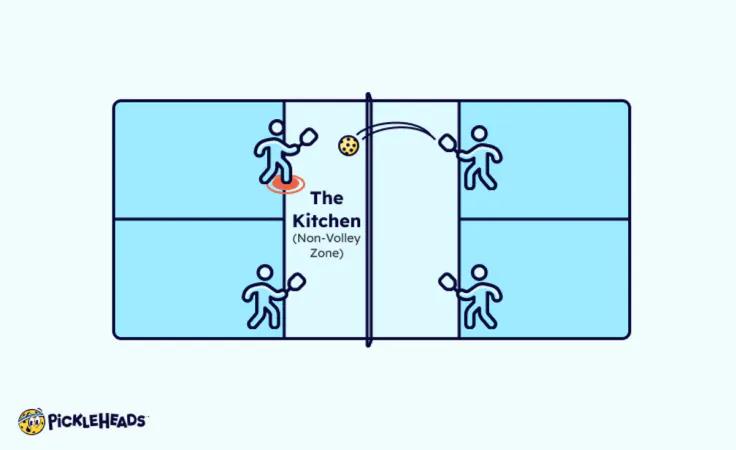
Image Source: cdn.sanity.io
The Pickleball Kitchen: Defining the Non-Volley Zone
The non-volley zone, or kitchen, is the area extending 7 feet from each side of the net. It’s marked by a distinct line, the kitchen line, which is also 7 feet from the net. This zone is designed to prevent players from standing at the net and smashing every shot, promoting softer play and longer rallies.
Why the Kitchen Exists
The primary purpose of the kitchen is to encourage a different style of play. Without it, players could simply camp out at the net, volleying every ball with powerful overheads. This would make the game less accessible and more about raw power than skill and placement. The kitchen forces players to be more strategic, develop touch shots, and engage in more dynamic net play.
Key Restrictions in the Kitchen
The most important rule concerning the kitchen is that players cannot volley a ball while any part of their body is in the non-volley zone. A volley is a shot hit before the ball bounces. This applies even if you are reaching over the kitchen line to hit the ball.
Furthermore, you cannot enter the kitchen to hit a volley. This means if you step into the kitchen, even to retrieve a ball, and hit it before it bounces, it’s a fault.
Deciphering Kitchen Violations
Kitchen violations occur when a player breaks the non-volley zone rules. These are critical to avoid for successful play.
Volleying in the Kitchen
- The Action: A player stands inside the kitchen (or touches the kitchen line) and hits the ball in the air before it bounces.
- The Result: This is a fault, and the rally ends. The opposing team scores a point.
Momentum and the Kitchen
A common area of confusion involves momentum. If you hit a volley outside the kitchen, but your momentum carries you into the kitchen after you hit the ball, it is still a fault.
- The Action: A player hits a volley from outside the kitchen, and then their momentum causes them to land or step into the kitchen before the ball bounces or before their opponent returns it.
- The Result: This is a fault. Even if the initial hit was legal, the subsequent movement into the kitchen makes it a violation.
Touching the Kitchen Line
The kitchen line itself is considered part of the non-volley zone.
- The Action: A player’s foot or any other part of their body touches the kitchen line while they are volleying.
- The Result: This is a fault.
Reaching into the Kitchen
You cannot reach into the kitchen to hit a volley.
- The Action: A player stands outside the kitchen but reaches their paddle or arm into the kitchen to hit a volley.
- The Result: This is a fault. The entire body’s position relative to the kitchen when volleying is key.
Ball Hitting You in the Kitchen
If a ball you are about to hit bounces in the kitchen, and you are in the kitchen when it bounces, you can hit it. However, if you are in the kitchen and the ball bounces in front of you (closer to the net) and you then hit it, you are still violating the rule because you are in the kitchen. The rule applies to hitting the ball before it bounces while in the kitchen.
- The Action: A player is standing in the kitchen. The ball bounces in front of them (towards the net) within the kitchen. The player then hits the ball after the bounce.
- The Result: This is a legal shot. You can hit a ball after it bounces, even in the kitchen, as long as you are not volleying.
- The Action: A player is standing in the kitchen. The ball bounces in front of them (towards the net) within the kitchen. The player then hits the ball before it bounces (a volley).
- The Result: This is a fault.
Partner’s Momentum
What if your partner steps into the kitchen after you hit a volley? If your partner’s momentum carries them into the kitchen and they touch the kitchen line, or they hit a volley in the kitchen, it is a fault for your team.
Fathoming Pickleball Net Play and the Kitchen
The kitchen is central to pickleball net play. It dictates where and how players can engage in aggressive or defensive net strategies.
The Pickleball Dink Shot
The pickleball dink shot is a soft, arcing shot hit into the opponent’s kitchen. This shot is fundamental to kitchen play.
- Purpose: To keep the ball low and out of reach of aggressive volleys, forcing opponents to hit up, or to draw them forward.
- Placement: Ideally, the dink lands just over the net and drops directly into the opponent’s kitchen.
- Kitchen Necessity: Dinking is often performed while standing outside or right at the kitchen line. Players will often move forward to the kitchen line to execute a dink.
Offensive Kitchen Play
When a team has control of the net, they can employ offensive strategies within or near the kitchen.
- Third Shot Drop: This is a crucial offensive strategy. After the serve and return, the third shot is often a soft “drop” shot aimed at landing in the opponent’s kitchen. This shot neutralizes the opponent’s advantage at the net and allows the serving team to advance.
- Aggressive Dinking: Teams at the net can engage in a “dink rally,” where they trade soft shots back and forth, trying to create an opening or force an error.
- Attacking the Kitchen: Players outside the kitchen can move forward to attack balls that are short or high in the kitchen, but they must be careful not to volley.
Defensive Kitchen Play
When a team is defending at the net, the kitchen becomes a safe zone to receive softer shots.
- Receiving Dinks: Players will often stand near the kitchen line to receive dink shots, aiming to return them with their own dinks or to pass the opponent.
- Resetting the Rally: The kitchen allows players to “reset” a rally by hitting a soft shot into the opponent’s kitchen, slowing down the pace and regaining defensive positioning.
Mastering Pickleball Serve Rules and the Kitchen
The pickleball serve rules are the starting point of every rally, and they indirectly involve the kitchen.
Serving into the Kitchen
- The Rule: A serve must clear the non-volley zone (kitchen) and land in the opponent’s service court.
- Violation: If a serve lands in the kitchen, it is a fault.
The Third Shot Drop and Serve Strategy
The serve’s primary goal is to make it difficult for the returning team to execute an effective return, ideally setting up the serving team to advance to the net. The serve’s placement can influence the third shot drop.
- Deep Serve: A deep serve pushes the returner back, making it harder to hit a strong offensive return. This can create an opportunity for the serving team to hit a third shot drop into the kitchen.
- Short Serve: While less common, a short serve that lands in front of the returner might tempt them to rush the net, which the serving team could then try to exploit.
Strategic Positioning and the Kitchen
Where you stand relative to the kitchen dramatically impacts your game.
Beyond the Kitchen Line
Playing outside the kitchen line offers a wider range of shots, including aggressive volleys and overheads. However, you are more vulnerable to well-placed dinks.
At the Kitchen Line
This is where much of the strategic battle takes place. Players at the kitchen line are poised to:
- Execute dink shots effectively.
- React to opponent’s dinks.
- Be ready to volley if the ball comes high enough, but only if they are outside the kitchen.
Inside the Kitchen
As discussed, being inside the kitchen is generally restrictive for volleys. It’s a place to stand after a ball has bounced if you’re waiting for a return, or if you’re anticipating a shot that you can legally hit after it bounces.
Advanced Kitchen Tactics
Once you’ve grasped the basic rules, you can explore more advanced strategies involving the kitchen.
The Third Shot Drop vs. The Drive
The third shot can be a drop into the kitchen or a hard “drive.”
- Third Shot Drop: Aims to land in the kitchen, neutralizing the net position and allowing the serving team to advance.
- Third Shot Drive: A powerful shot aimed at the opponent, often at their feet or legs, trying to elicit a weak return or a pop-up. A successful drive can also allow the serving team to advance.
Using the Kitchen to Your Advantage
- Forcing opponents into the kitchen: If an opponent is too close to the net, a well-placed dink can force them to hit a weak upward shot from within the kitchen, setting you up for a put-away.
- Deception: Feinting a powerful shot and then dinking softly into the kitchen can catch opponents off guard.
Common Misconceptions About the Kitchen
Even experienced players can sometimes misunderstand certain nuances of the kitchen rules.
“I didn’t touch the line, so it’s okay.”
Remember, the kitchen extends 7 feet from the net. Touching the line is a violation, but even stepping over the line to volley is a violation, regardless of touching the line itself.
“My partner was in the kitchen, but I wasn’t.”
In doubles, if one partner commits a kitchen violation, it’s a fault for both players.
“The ball bounced once, so I can hit it anywhere.”
While you can hit a ball after it bounces anywhere on the court, you still cannot be in the kitchen and volley the ball. If the ball bounces in the kitchen, and you are in the kitchen, you can hit it after the bounce. If you step into the kitchen to hit a ball that has bounced in the kitchen, that’s fine. The restriction is on volleys from within the kitchen.
Pickleball Kitchen Rules: A Quick Reference
Here’s a simplified table summarizing key kitchen interactions:
| Scenario | Outcome | Explanation |
|---|---|---|
| Volleying a ball while any part of your body is in the kitchen. | Fault | You cannot hit a ball in the air before it bounces while you are in the non-volley zone. |
| Stepping into the kitchen to hit a volley. | Fault | Your momentum or deliberate action of stepping into the kitchen to volley is a violation. |
| Touching the kitchen line while volleying. | Fault | The kitchen line is considered part of the non-volley zone. |
| Your momentum carries you into the kitchen after a legal volley. | Fault | Even if your hit was legal, if your follow-through makes you touch the kitchen or step in it, it’s a fault. |
| A served ball lands in the kitchen. | Fault | Serves must clear the kitchen. |
| Hitting a ball after it bounces while you are in the kitchen. | Legal | You can hit a ball after it bounces, regardless of your position on the court, as long as it’s not a volley. |
| Your partner commits a kitchen violation. | Fault (for the team) | In doubles, a violation by one player results in a fault for the team. |
| Reaching your paddle into the kitchen to volley. | Fault | Your paddle is an extension of your body; if it’s in the kitchen and you volley, it’s a fault. |
| Hitting a dink shot that lands in the opponent’s kitchen. | Legal | This is a fundamental offensive tactic. |
| Returning a dink shot from within the kitchen (after bounce). | Legal | You can play the ball after it bounces while you are in the kitchen. |
Frequently Asked Questions (FAQ)
Q1: Can I stand in the kitchen?
A: Yes, you can stand in the kitchen, but you cannot volley a ball while you are in the kitchen. You can also enter the kitchen to hit a ball after it bounces.
Q2: What is a volley in pickleball?
A: A volley is a shot that is hit before the ball bounces on your side of the court.
Q3: Does the kitchen include the kitchen line?
A: Yes, the kitchen line is considered part of the non-volley zone. Touching the line while volleying is a fault.
Q4: Can I step into the kitchen to hit a ball that bounced there?
A: Yes, you can step into the kitchen to hit a ball after it bounces. The rules against being in the kitchen only apply to volleys.
Q5: What happens if my momentum carries me into the kitchen after I hit a legal volley?
A: If your momentum causes you to touch the kitchen or step into it before the ball is returned by your opponent, it is a fault.
Q6: Can I hit a pickleball dink shot from inside the kitchen?
A: You can hit a dink shot from inside the kitchen, but only if the ball bounces first. You cannot volley a dink from inside the kitchen.
Q7: What are the pickleball serve rules regarding the kitchen?
A: A serve must travel over the net and land in the opponent’s service court, which means it must clear the kitchen. If a serve lands in the kitchen, it is a fault.
Q8: Is there a difference between offensive and defensive kitchen play?
A: Yes. Offensive kitchen play involves using the area near the net to your advantage, such as with a third shot drop or aggressive dinking. Defensive kitchen play involves using the kitchen area to absorb opponent shots, like returning dinks with more dinks to reset the point.
Q9: Can I reach over the kitchen line to hit a volley if my feet are outside?
A: No. If any part of your body, including your arm or paddle, crosses the plane of the kitchen line to hit a volley, it is a fault.
Q10: If my partner is in the kitchen and commits a fault, does it affect me?
A: Yes. In doubles, if one partner commits a fault, the rally ends, and it’s a fault for the team.
By internalizing these pickleball kitchen rules and practicing your net play, you’ll find your game improving significantly. The kitchen is not just a barrier; it’s a strategic tool that adds immense depth and excitement to every pickleball match.