
Image Source: cdn.kitchencabinetkings.com
DIY Success: How To Measure For Cabinets In Kitchen Guide
What is the best way to measure kitchen cabinets? The best way to measure kitchen cabinets involves careful steps. You must start with a clean space. Use the right tools, and draw a clear sketch of your kitchen. This guide will walk you through each step. Accurate measurements are key to a successful kitchen remodel. They help you pick the right kitchen cabinet dimensions. They make sure everything fits well and looks good.
Why Accurate Cabinet Measuring Matters
Measuring for cabinets might seem hard. But it is a very important step. Good measurements save you time. They save you money too. If your measurements are wrong, cabinets might not fit. You could have gaps. Or they might be too big. This means more work and extra costs. Precise measurements help you plan your kitchen layout planning well. They ensure your new kitchen feels right.
Getting Ready to Measure
Before you pick up your tape measure, do some prep work. This makes the job easier. It also makes your measurements more exact.
Clear Your Space
Take everything out of your kitchen. This includes loose items, small appliances, and furniture. A clear space gives you room to work. It helps you see the true shape of your kitchen. Remove old cabinets if you are replacing them. This shows you the bare walls. It helps you get the most accurate numbers.
Gather Your Tools
Having the right tools is important. They help you get correct measurements.
- Steel Tape Measure (at least 25 feet): A long, stiff tape measure is best. Fabric or floppy tapes can stretch. This leads to wrong numbers.
- Paper and Pencil: For writing down numbers.
- Graph Paper: This helps you draw your kitchen sketch to scale. Each square can stand for a certain amount, like 6 inches or a foot.
- Level: To check if surfaces are flat. Walls might not be perfectly straight. A level helps you see this.
- Stud Finder: To find wall studs. These are important for hanging cabinets safely.
- Camera or Smartphone: To take photos of your kitchen. These pictures help you remember details later. They can show things you might miss in your sketch.
How to Measure Your Kitchen: Step-by-Step
Follow these steps closely. Write down every measurement you take.
Draw a Simple Sketch
Do not worry about making a perfect drawing. A rough sketch is fine. It helps you organize your measurements.
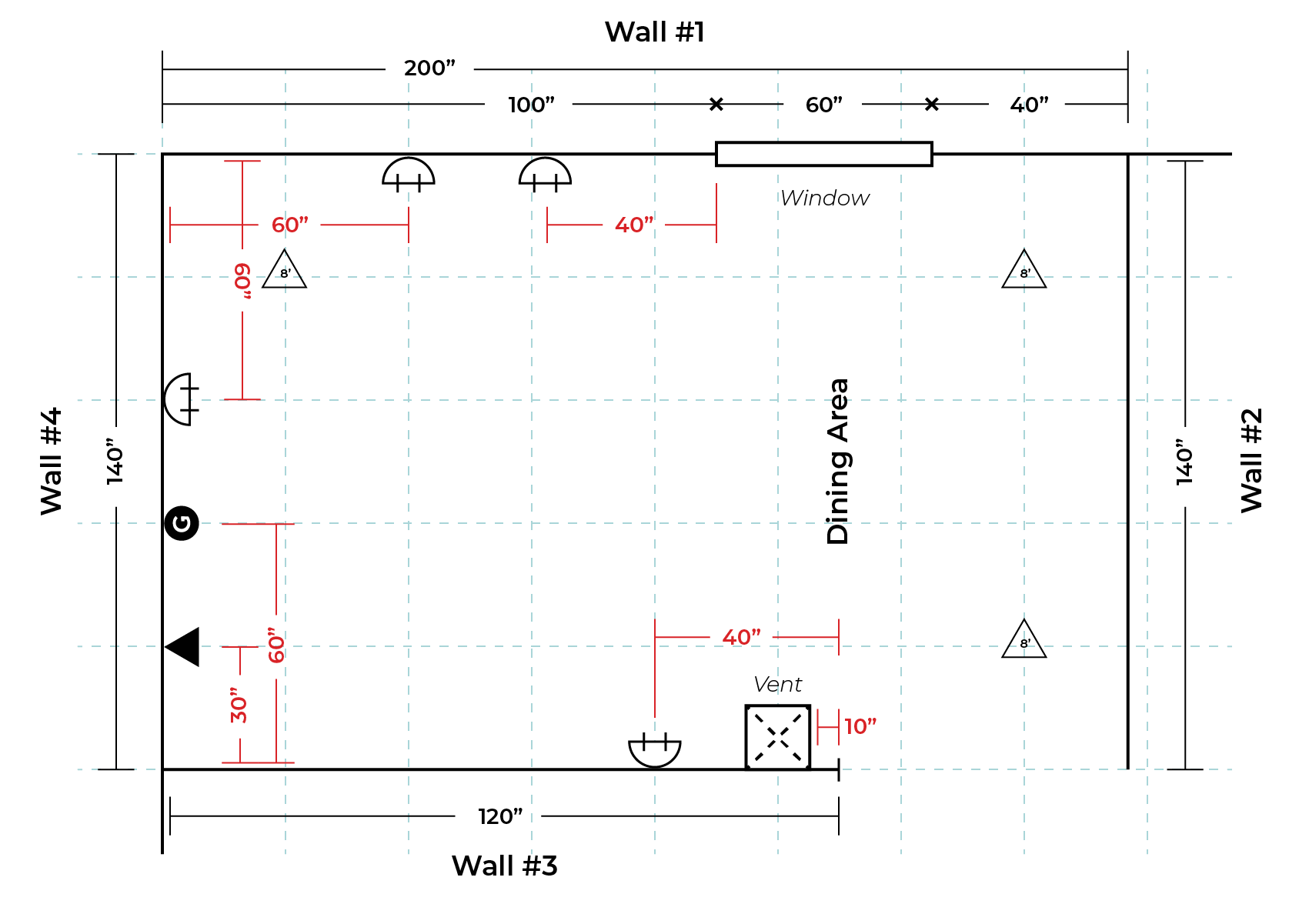
- Draw the room: Draw each wall. Show where doors, windows, and large appliances are.
- Add details: Put marks for outlets, light switches, and water lines.
- Label: Write down labels for each wall. For example, “Wall A,” “Wall B,” and so on.
Measure the Overall Walls
Start with the basics. Measure the full length and height of each wall.
- Wall-to-wall measurements: Measure from one corner to the other. Do this for every wall. Measure at least three different heights:
- Near the floor
- At counter height (about 36 inches up)
- Near the ceiling
- Walls are often not perfectly straight. Using three measurements helps you find the shortest length. This is what you must plan for.
- Ceiling height: Measure from the floor to the ceiling. Do this in a few spots around the room. Floors and ceilings can be uneven. Write down the shortest height you find. This number is key for
upper cabinet height.
Mark Doors and Windows
Doors and windows take up wall space. You cannot put cabinets there. So, you need to measure them carefully.
- Measure from corners to door/window edges: Measure from the wall corner to the edge of the door or window frame. Do this on both sides.
- Measure door/window width: Measure the width of the door or window opening. Measure the width of its trim too.
- Measure door/window height: Measure from the floor to the top of the door or window frame. Measure the height of its trim too.
- Measure from floor to window sill: This tells you how high up your window starts. This is important for
base cabinet measurements. - Measure from window header to ceiling: This tells you the space above the window. You might be able to put a small cabinet or shelving here.
Locate Appliances and Utilities
You need to know where your large appliances will go. You also need to mark where water, gas, and power are. These things affect where cabinets can be placed.
- Measure current appliance spaces: If you have existing appliances, measure their widths, depths, and heights. Write these numbers down. Also, measure the space set aside for new ones. These are
appliance rough openings. For example, a standard dishwasher space is 24 inches wide. A standard refrigerator space is often 36 inches wide. - Mark plumbing lines: Note where your sink and dishwasher water lines are. Also, mark the drain pipe.
- Mark electrical outlets and switches: Write down their exact spots. Measure how far they are from the floor and from the nearest wall corner.
- Mark gas lines: If you have a gas stove or oven, mark the gas line spot.
- Mark HVAC vents: Note any heating or cooling vents on the walls or floor. Cabinets cannot block these.
Deciphering Cabinet Measurements
Now that you have your basic room measurements, let’s look at cabinet sizes. Cabinets come in many standard cabinet sizes. Knowing these helps you plan.
General Rules for Cabinet Measuring
- Always measure three times: This cannot be said enough. Measure, write it down, measure again, write it down, measure a third time. If the numbers are different, find out why.
- Measure in inches and fractions: Kitchen cabinets are typically measured in inches. Use fractions like 1/4″, 1/2″, 3/4″ for precision. Do not use decimals.
- Write down every number clearly: Label each measurement on your sketch. Make sure you can tell what each number means later.
Grasping Base Cabinet Measurements
Base cabinets sit on the floor. They are topped with a counter. They form the lower part of your kitchen.
- Standard depths and heights:
- Height: Most base cabinets are 34.5 inches high. This does not include the countertop. With a standard 1.5-inch thick counter, the finished height is 36 inches.
- Depth: Standard base cabinets are 24 inches deep from front to back. This depth often includes the door.
- Common widths:
Standard cabinet sizesfor base cabinets range from 9 inches to 48 inches. They usually go up in 3-inch steps (e.g., 9, 12, 15, 18, 21, 24, 27, 30, 33, 36, 42, 48 inches). - Planning for fillers: You might have gaps between cabinets and walls. Or between cabinets and appliances. These small gaps are filled with “filler strips.” These are pieces of wood that match your cabinets. They are cut to size on site. They help make a clean, finished look. You usually need at least 1-2 inches of filler next to a wall or large appliance. This lets doors and drawers open fully.
- Where to start measuring for base cabinets:
- Start from a corner. Measure out the length of the wall where base cabinets will go.
- Subtract space for appliances. For example, if you have a 30-inch stove, subtract that from your total wall length.
- Divide the remaining space into cabinet widths. Try to use common widths first.
- Factor in filler strips as needed.
Table: Common Base Cabinet Measurements
| Feature | Standard Measurement (Inches) | Notes |
|---|---|---|
| Cabinet Height | 34.5 | Without countertop |
| Countertop Height | 1.5 | Standard thickness, makes total 36 inches |
| Cabinet Depth | 24 | From front to back, including door |
| Common Widths | 9, 12, 15, 18, 21, 24, 27, 30, 33, 36, 42, 48 | Most common widths, often in 3-inch steps |
Wall Cabinet Measurements Made Easy
Wall cabinets hang on the wall above the base cabinets. They provide extra storage.
- Standard depths and heights:
- Depth: Standard wall cabinets are usually 12 or 15 inches deep. Some are 18 or 24 inches deep, often for over-refrigerator or microwave spaces.
- Height:
Standard cabinet sizesfor wall cabinets vary more. Common heights are 12, 15, 18, 24, 30, 36, and 42 inches. The height you choose depends on your ceiling height and how high you want them above your counter.
- Height above counters: Most wall cabinets are hung 18 inches above the countertop. This leaves enough space for small appliances. It also allows for comfortable workspace.
- Height to ceiling:
- If you have an 8-foot (96-inch) ceiling:
- 36 inches (base cabinet + counter) + 18 inches (space above counter) = 54 inches.
- 96 inches (ceiling height) – 54 inches = 42 inches. You can fit 42-inch tall wall cabinets.
- If you have a 9-foot (108-inch) ceiling:
- 108 inches – 54 inches = 54 inches. You could use 42-inch cabinets with a decorative trim above. Or stack shorter cabinets.
- This is part of
kitchen cabinet dimensionsplanning. You need to know yourupper cabinet heightlimits.
- If you have an 8-foot (96-inch) ceiling:
- Working with varying
kitchen cabinet dimensions: Sometimes, you might mix cabinet heights for a custom look. For example, taller cabinets over a fridge, shorter ones elsewhere. This adds visual interest.
Table: Common Wall Cabinet Measurements
| Feature | Standard Measurement (Inches) | Notes |
|---|---|---|
| Cabinet Depth | 12, 15 (less common: 18, 24) | From front to back, including door |
| Common Heights | 12, 15, 18, 24, 30, 36, 42 | Chosen based on ceiling height and preference |
| Height Above Counter | 18 | Standard clearance for small appliances |
Corner Cabinet Dimensions: A Special Focus
Corners are often tricky. They need special cabinets to make the most of the space.
- Lazy Susan cabinets: These often have rotating shelves. They are popular for base corners.
Corner cabinet dimensionsfor a standard base Lazy Susan are usually 33×33 inches or 36×36 inches. This means they need 33 or 36 inches of wall space on each side of the corner. - Blind corner cabinets: These cabinets extend into the corner. Part of the cabinet is “blind” or hidden. You access it through a door on one side.
- Base blind corner: A typical base blind corner cabinet might be 36-42 inches wide on one side. This makes it reach into a corner. It needs 36 to 42 inches of wall space on one side. It needs 24-27 inches on the other side. These
base cabinet measurementsare important. - Wall blind corner: Similar idea for wall cabinets.
Wall cabinet measurementsfor these are around 24-27 inches on one side and 30-36 inches on the other.
- Base blind corner: A typical base blind corner cabinet might be 36-42 inches wide on one side. This makes it reach into a corner. It needs 36 to 42 inches of wall space on one side. It needs 24-27 inches on the other side. These
- Measuring for corner base and wall cabinets:
- Measure from the corner out along both walls.
- Decide which type of corner cabinet you want (Lazy Susan, blind corner).
- Check the manufacturer’s exact
corner cabinet dimensions. They can vary a little. Make sure the cabinet fits the wall space you have.
Crafting Your Kitchen Layout Planning
Once you have all your measurements, it is time to plan. Use your sketch and the cabinet measurement guide you have been building.
Use Your Measurements
Transfer all your detailed numbers to your graph paper sketch. This makes it a working blueprint. You can now start placing cabinets and appliances.
Place Appliances First
Start by marking where your sink, stove, refrigerator, and dishwasher will go. These are fixed points. Their appliance rough openings are set. Build your kitchen around them. For example, a dishwasher usually goes next to the sink for easy plumbing.
Fit in Cabinets
Now, start placing your cabinets.
- Start with corners: Place your chosen
corner cabinet dimensionsfirst. These often dictate the rest of the layout on those walls. - Add straight runs: Fill in the spaces between appliances and corners with
standard cabinet sizes. Try to use cabinets that fit well. Rememberbase cabinet measurementsandwall cabinet measurements. - Use filler strips if needed: If you have small gaps, plan for filler strips. It is better to use a small filler than to force a cabinet that is too big.
Measuring for Custom Cabinets
Most people buy stock or semi-custom cabinets. But sometimes, you might want measuring for custom cabinets.
When to Choose Custom
You might choose custom cabinets if:
* Your kitchen has very unusual shapes or angles.
* You want specific kitchen cabinet dimensions not available in standard sizes.
* You want unique features or materials.
* You have a very high budget.
What Custom Measuring Changes
When you are measuring for custom cabinets, the process is even more precise.
* More precise dimensions needed: Custom cabinet makers will often come to your home. They will take their own very exact measurements. They can build cabinets to fit any space down to the fraction of an inch.
* Working with a professional: If you go custom, a professional will guide you. But your initial measurements are still helpful. They give the custom cabinet maker a good starting point.
A Comprehensive Cabinet Measurement Guide
Let’s sum up the key points for your cabinet measurement guide.
Key Things to Remember
- Double-check everything: This is the most important rule. Measure at least twice, preferably three times.
- Consider obstructions: Do not forget things like radiators, heating vents, or pipes. Cabinets cannot go over these.
- Think about how doors open: Make sure cabinet doors and drawers can open fully without hitting walls or other cabinets. This is especially true for corner cabinets and those next to walls. You might need a small filler strip here.
- Measure electrical and plumbing: Note where all power outlets, switches, water lines, and gas lines are. These spots affect where you can place cabinets and appliances.
Common Mistakes to Avoid
Even careful DIYers can make errors. Watch out for these common mistakes:
- Not clearing the space: Leaving items in the kitchen makes it hard to get true measurements.
- Using a flimsy tape measure: A cloth tape or short, bendy metal tape will give wrong numbers.
- Not measuring in three spots: Walls and floors are rarely perfectly straight. Measuring at top, middle, and bottom shows you the true limits.
- Forgetting obstructions: Ignoring radiators, pipes, or vents leads to cabinets that do not fit.
- Ignoring appliance sizes: Not knowing the exact
appliance rough openingsmeans your fridge or oven might not slide in. - Not planning for fillers: Forgetting filler strips can mean cabinet doors cannot open fully, or you have awkward gaps.
- Measuring only once: This is the biggest mistake. Always verify your numbers.
Final Checks and Tips
You have your measurements. You have your layout ideas. What next?
Review Your Sketch
Look over your entire sketch. Does it make sense? Do all the numbers add up? Is there enough space around doors and windows? Have you accounted for all kitchen cabinet dimensions?
Get a Second Opinion
Ask a friend or family member to look at your measurements and sketch. Sometimes, a fresh pair of eyes sees something you missed. They might spot a mistake or offer a good idea.
Think About Future Changes
Are you planning to add a new appliance later? Will you change flooring? Think about how these might affect your cabinet needs. Planning ahead can save trouble later.
Frequently Asked Questions (FAQ)
Q1: How much space should be between the countertop and upper cabinets?
A1: The standard space is 18 inches. This allows most small appliances to fit comfortably. It also leaves good work space.
Q2: Can I reuse my old cabinets?
A2: Yes, if they are in good shape. You will still need to measure your kitchen accurately. This helps you plan where the old cabinets will go.
Q3: What if my walls are not straight?
A3: This is very common. Always measure in several spots (top, middle, bottom). Plan your cabinets based on the shortest measurement. You can use filler strips to hide any gaps from uneven walls.
Q4: Do I measure to the inside or outside of door and window frames?
A4: Measure to the outside of the trim. Cabinets cannot sit on top of door or window trim. This ensures proper clearance.
Q5: How do I plan for a corner sink cabinet?
A5: Corner sink cabinets are special. They use up a lot of wall space in the corner. They usually need about 36 inches from the corner on each wall. Make sure to check the specific corner cabinet dimensions from the cabinet maker.